Because I did not found a tool to create graphs (the way I want it)
from exim logs, I wrote a little bash script that suits my needs.
Example graph:
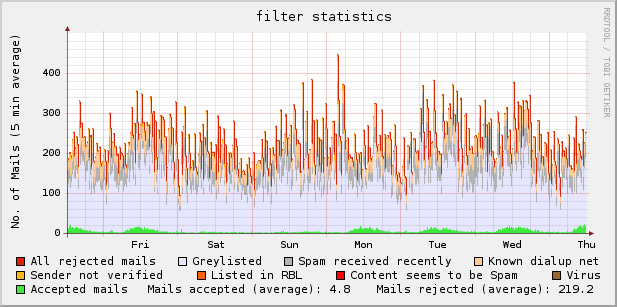
Download: exim_rrd-0.9.5.1 (updated 2009-03-07 [bugfix])
I’m not a programmer, so the script can be improved – no question : )
If you have any hints, please tell me.
Usage: run as cronjob, i.e.
# mail statistic

*/5 * * * * /usr/local/bin/exim_rrd > /dev/null 2> /dev/null
dependencies:
rrdtool [ http://oss.oetiker.ch/rrdtool/ ] ^ thanks to Tobias Oetiker
(e)grep
– – – – – – – – – – – – – – – – – – – – – – – – – – – – – – – – – – – – – – – – – – – – –
tested with:
rrdtool 1.2.23, rrdtool 1.2.27
openSUSE 10.3 (i586), exim 4.69 main log
openSUSE 11.0 (i586), exim 4.69 main log
Category Archives: Mailserver
Should I use DNSBL?
RBLs – yes / no.. a big discussion always..
Right now, I can recommend zen.spamhaus.org & ix.dnsbl.manitu.net (<- especially for german MXs).
I’ve never seen a false positive on these lists ..
Nevertheless, use the lists for scoring (i.e. with spamassassin), not for instant blocking!
Nowadays, prosecuting “backscatter”, sender callouts, etc. seems to be a new trend – and it could be useful in future..
I’ve tested the only free list I know – backscatterer.org.
Don’t you use that one for immediate blocking!
Scoring can be ok, but even there – watch your logs!
Some “hits” (from a test run) to show what I found:
…
2008-03-04 17:17:42 H=lizzard.sbs.de [194.138.37.39] – possible backscatter
2008-03-04 17:21:59 H=mail.space.net [195.30.0.8] – possible backscatter
2008-03-04 17:25:33 H=relay4.ptmail.sapo.pt [212.55.154.24] – possible backscatter
2008-03-04 17:32:46 H=relay23.arbeitsagentur.de [212.204.77.151] – possible backscatter
2008-03-04 17:33:38 H=mout1.mail.vrmd.de [81.28.224.19] – possible backscatter
2008-03-04 17:48:33 H=dgate1.fujitsu-siemens.com [217.115.66.35] – possible backscatter
2008-03-04 17:50:05 H=mailout05.sul.t-online.de [194.25.134.82] – possible backscatter
2008-03-04 17:51:27 H=relay0-0.brigade.com [209.249.158.73] – possible backscatter
2008-03-04 18:04:42 H=mailout07.sul.t-online.de [194.25.134.83] – possible backscatter
2008-03-04 18:11:21 H=bay0-omc2-s24.bay0.hotmail.com [65.54.246.160] – possible backscatter
2008-03-04 18:13:37 H=mail.space.net [195.30.0.8] – possible backscatter
2008-03-04 18:13:42 H=smtp1.versatel.nl [62.58.50.88] – possible backscatter
2008-03-04 18:15:29 H=mailout09.sul.t-online.de [194.25.134.84] – possible backscatter
2008-03-04 18:16:33 H=ip17.be3a.com (be3a.com) [213.92.9.17] – possible backscatter
2008-03-04 18:18:12 H=gamwsm02.mwga.mailwatch.com [216.157.255.16] – possible backscatter
2008-03-04 18:20:15 H=aps67.muc.ec-messenger.com [195.140.186.67] – possible backscatter
2008-03-04 18:22:56 H=mout1.mail.vrmd.de [81.28.224.19] – possible backscatter
2008-03-04 18:25:46 H=mail.gmx.net [213.165.64.20] – possible backscatter
2008-03-04 18:27:56 H=mail004.thyssenkrupp.com [149.211.153.66] – possible backscatter
2008-03-04 18:30:43 H=mailout04.sul.t-online.de [194.25.134.18] – possible backscatter
2008-03-04 18:33:06 H=mailout03.sul.t-online.de [194.25.134.81] – possible backscatter
2008-03-04 18:39:33 H=mail.gmx.net [213.165.64.20] – possible backscatter
2008-03-04 18:45:20 H=mail.schule.bayern.de [194.95.207.92] – possible backscatter
2008-03-04 18:48:56 H=skibayf20.kirche-bayern.de [141.78.101.100] – possible backscatter
…
A lot of the BIG players (german companies in this example mainly) are found on the list ..
So don’t get yourself in trouble with users that complain all day long and think about what you’re blocking ..
Any suggestion/comment ist highly appreciated.
postfix / (mass) remove mails from queue
A little hack to remove mails for a specific recipient from the postfix mail queue:
mailq | tail +2 | awk 'BEGIN { RS = "" } \

/ user@example\.tld$/ { print $1 } \

' | tr -d '*!' | postsuper -d -
exim / implementing greylisting without db
I had greylisting running for a while with a little perl script, that only worked with ip-addresses. As spam is growing an growing, I wanted to use the whole triplet (ip/sender/recipient) for the filter.
As I did not want to use a database backend, the decision led to greylistd – an easy configurable daemon. I needed the packages for (open)SuSE, that can be found in openSuSE’s software repository.
After installing it and checking the basics at /etc/greylistd/config, you have to add a little code to your acls in exim.conf, i.e.:
defer message = greylisted $sender_host_address. please try again later

condition = ${readsocket{/var/run/greylistd/socket}\

{--grey $sender_host_address $sender_address $local_part@$domain} {5s}{}{false}}
That was all I had to do to get it working. It’s advisable to add some hosts, that are known for problems with greylisting, not to be checked. Therefor you have to extend your acl:
defer message = greylisted $sender_host_address. please try again later

!hosts = : ${if exists {/etc/greylistd/whitelist-hosts}\

{/etc/greylistd/whitelist-hosts}{}} : \

${if exists {/var/lib/greylistd/whitelist-hosts}\

{/var/lib/greylistd/whitelist-hosts}{}}

condition = ${readsocket{/var/run/greylistd/socket}\

{--grey $sender_host_address $sender_address $local_part@$domain} {5s}{}{false}}
Many thanks for the documentations from Arne Schirmacher and Ben Charlton.
exim / remove (all) frozen messages from queue
Just a quick & dirty hack to delete frozen messages for a single / some recipient(s)…
#!/bin/bash

#

# what are we searching for?

# (part of the email-address)

SEARCH="anyrecipient.tld"

#

# exim-bin

EXIM=`which exim`

#

# execute (frozen messages only)..

$EXIM -Mrm $(mailq | grep $SEARCH -B1 | grep frozen |cut -c 11-27)
Thanks to Mark -> this can be done a lot of easier if you want to kill all frozen messages:
exiqgrep -z -i | xargs exim -Mrm
If you want to do this only for some domains / email-addresses, use the first example.
PAM-Authentication & MySQL (v5) / b1gMail
Enviroment:
- SuSE Linux 10.1
- pam-0.99.3.0-29.3, pam-modules-10.1-7
- postfix-2.2.9-10
- mysql-5.0.18-20.8, mysql-client-5.0.18-16
I was trying to implement SASL-authentication via PAM (which is using a mysql-backend) in a postfix installation.
Output from maillog:
postfix/smtpd: warning: SASL authentication failure: Password verification failed

postfix/smtpd: warning: [x.x.x.x]: SASL PLAIN authentication failed
Checking the syslog:
saslauthd: pam_b1gmail: cannot connect to mysql database

(Access denied for user 'xx'@'localhost' (using password: YES))

saslauthd: DEBUG: auth_pam: pam_authenticate failed: Permission denied

saslauthd: do_auth : auth failure: [user=xx] [service=smtp]

[realm=domain.tld] [mech=pam] [reason=PAM auth error]
Reason:
The PAM module is using a deprecated way to connect to the MySQL-DB.
Solution:
Set the MySQL-Password to OLD_PASSWORD:
SET PASSWORD FOR user'@'localhost' = OLD_PASSWORD('password');
Pimp my spamassassin / FuzzyOCR
Today I’ve implemented a new tool in our anti-spam system:
FuzzyOCR (Dec 13, 2007: URL contains ads only now)
It’s an OCR software used as a plugin for SpamAssassin.
OCR means “optical character recognition” and describes the procedure to recognize characters and words from images. It’s quite useful when you try to catch so-called “Image Spam”, which uses normal text where the real message is hidden in images (inline gifs, etc.)
The results are quite good and I’m confident : )
Additionally to the packages described on the homepage of FuzzyOCR you’ll need another piece of software (at least with openSuSE 10.0): giflib-progs-4.1.3-7.i586.rpm
Continue reading Pimp my spamassassin / FuzzyOCR
exim / filtering spam
A graph to show you how many UCE-Mails are filtered per week.
This is a statistic from one of my company’s mailservers.
From about 3000 mails per hour -> more than 90% of all traffic is spam, UCE or virus-infected mail!
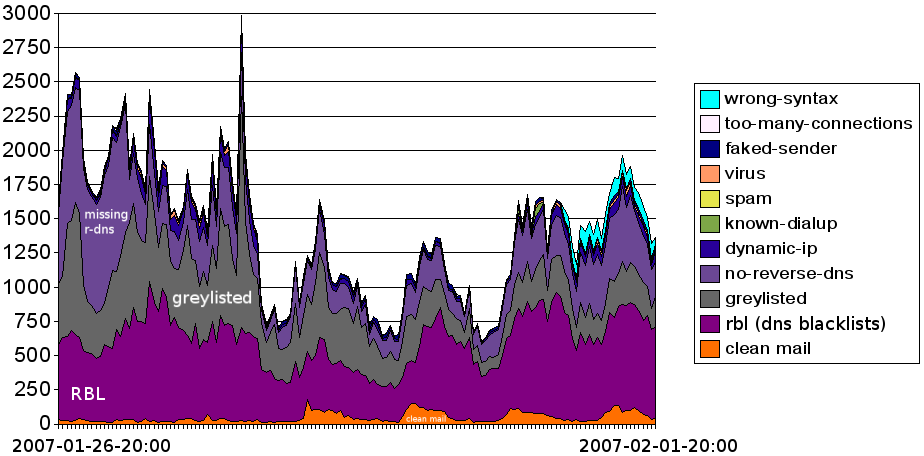
Explanation:
wrong-syntax: Somebody tried to fake a mail-programm
too-many-conn.: Anybody tried to send a mass-mail
faked-sender: Tried to spoof sender
virus: recognized virus (which was not blocked by other filters)
spam: recognized spam (which was not blocked by other filters)
known-dialup: known dialup notwork; normally no mail from here
dynamic ip: dialup network or forgot to set proper dns-reverse entry
no-reverse-dns: still allowed, but reverse dns should be set
greylisted: mail is rejected first time; after that it should be ok
rbl: dns blacklists
clean mail: passed through and should be ok
Pimp my exim / DynaStop
I found a (new) software that finally helps to ban spam that is not blocked by various dns blacklists, greylisting, etc …
Have a look at:
http://tanaya.net/DynaStop/
and the forum:
http://www.exim-users.org/forums/forumdisplay.php?f=36
2007/05/08: Update of my personal DynaStop Whitelist
Here you’ll find a great piece of software, that filters incoming mail on the basis of whether a dynamic IP address is used. This reduces system load and resources in processing unwanted mail because all legitimate mail from mainly all ISPs will be sent from a proper mail exchange server (respectively the dns name). Over 350 million IP addresses were used in testing DynaStop for integrity and stability in identifying dynamic addresses and cross checked false positives.
Although the software is still in beta status, I use it in my company to kick out the rest of unwanted connections that are not recognized by RBLs or those that “survive” greylisting.
Result:
- System load is massive reduced because of less work for spamassassin and antivirus-software
- Connections that come back multiple times and overwit greylisting are banned without scanning the message
- Combined with a daily-report (to control false positives) of blocked networks it’s really a powerful software